AEO (Answer Engine Optimization) is the practice of structuring content so search and AI systems can extract precise answers directly from your website. GEO (Generative Engine Optimization) focuses on positioning your brand to be recommended by AI-driven systems that generate responses, summaries, and suggestions. Together, AEO and GEO redefine how businesses earn visibility in 2026.
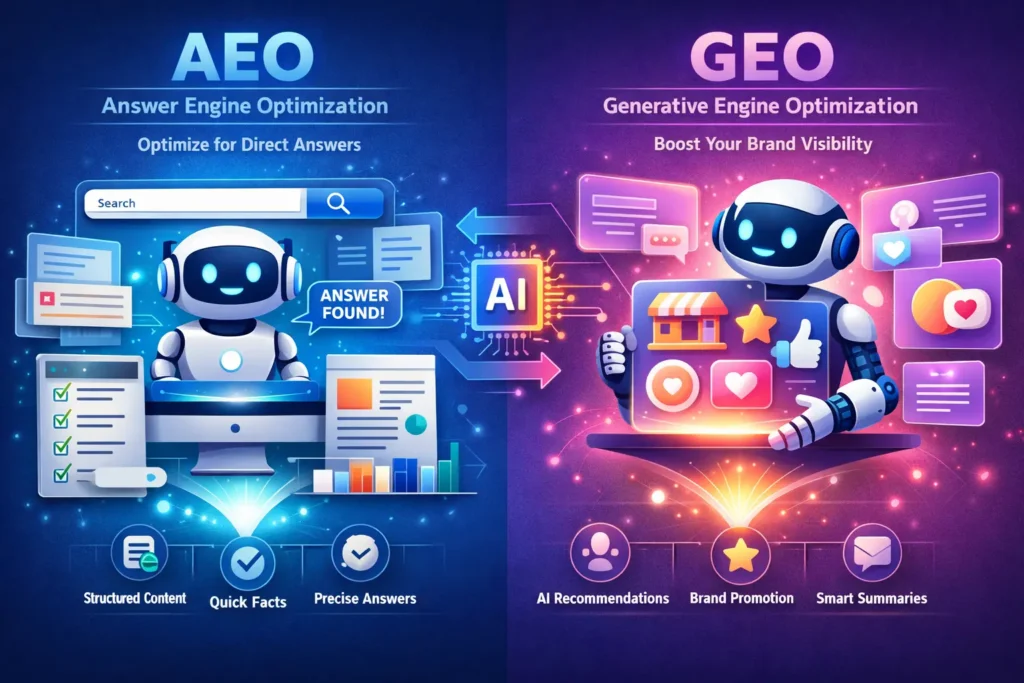
Traditional SEO aimed to rank pages. AEO aims to win answers. GEO aims to win recommendations.
In consulting engagements over the past few years, I’ve observed a consistent shift: clients are no longer asking, “Why am I not ranking?” They’re asking, “Why am I not being shown in AI summaries?” or “Why doesn’t ChatGPT recommend my service?”
That shift is structural, not temporary.
Search engines now extract. Generative systems now synthesize. Your strategy must adapt.
Importance of AEO and GEO in 2026
Search behavior has evolved in three significant ways:
- Users increasingly expect immediate answers rather than lists of links.
- AI-generated summaries reduce the need to click through websites.
- Recommendation-driven results influence buying decisions before users ever visit a page.
From Ranking to Answering
Previously, ranking in the top three positions meant visibility. Today, AI answer engines often display:
- Featured summaries
- Direct responses
- Conversational outputs
If your content is not structured for extraction, you may rank but remain invisible.
From Visibility to Recommendation
Generative systems do more than retrieve information. They recommend services, tools, and brands based on perceived authority, entity signals, and contextual trust.
A B2B SaaS startup placed #2 for a competitive term in one consultation case. However, AI-generated responses mentioned two competitors repeatedly but not them. The reason? Weak entity signals, limited brand mentions across authoritative sources, and inconsistent positioning.
Ranking alone was insufficient.
AEO and GEO exist because behavior has changed. Users now:
- Ask conversational questions
- Trust AI summaries
- Accept AI recommendations
Traditional SEO remains foundational, but it is no longer sufficient.
How AEO Works and Where It Appears
Answer Engine Optimization ensures your content is extractable and structured for direct response delivery.
Where AEO Appears
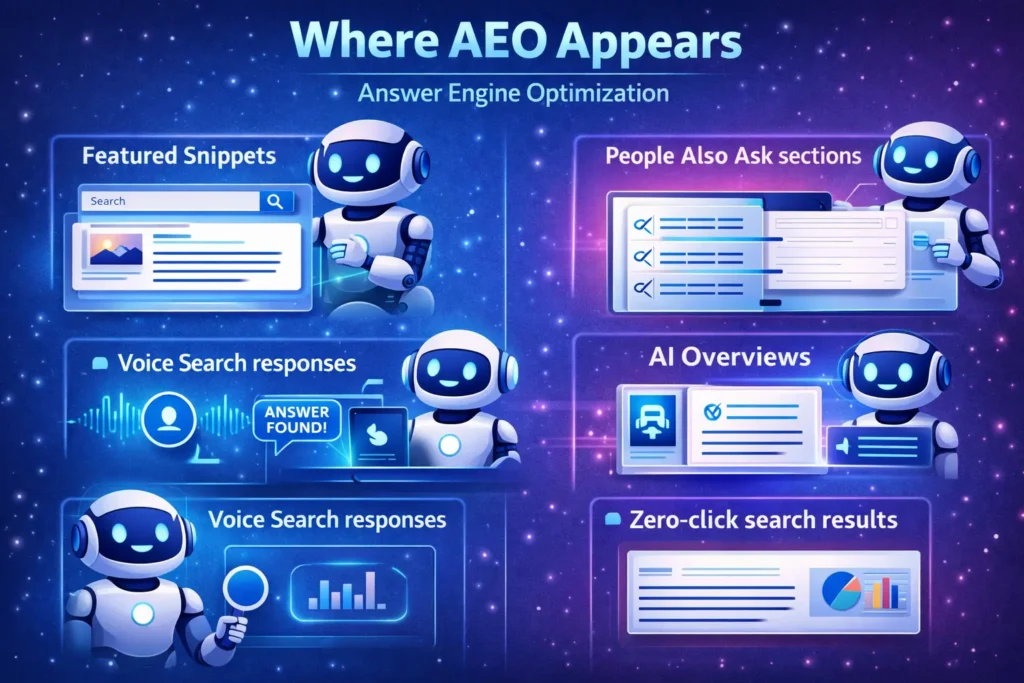
- Featured Snippets
- People Also Ask sections
- Voice Search responses
- AI Overviews
- Zero-click search results
When a search engine detects structured, clearly formatted, authoritative content, it extracts answer blocks.
What Triggers Extraction?
Extraction depends on:
- Clear question-based subheadings
- 40–60 word concise answers
- Logical paragraph flow
- Structured formatting
- Schema markup
- Authority signals
Search systems prefer content that reduces interpretation effort.
Mini Scenario
A healthcare clinic I worked with structured service pages using FAQ-based subheadings and concise 50-word answer blocks. Within two months, their content began appearing in People Also Ask sections. No backlinks were added. The change was structural.
AEO is not about writing more. It is about writing extractable answers.
AEO Strategic Framework
1. Search Intent Mapping
Map informational, navigational, and transactional queries. Prioritize question-based informational intent for extraction opportunities.
2. Question Clustering
Group semantically related questions. This improves topical authority and contextual understanding for AI systems.
3. Structured Answer Blocks
Provide 40–60 word direct answers under clear question subheadings. Avoid vague introductions before the answer.
4. Schema & Structured Data
To strengthen context, use structured markup, FAQ schema, and HowTo schema.
5. Authority Signal Building
Enhance author credibility, cite reputable sources, and maintain content accuracy.
AEO Implementation Checklist
- Identify high-intent question keywords
- Use H2/H3 question formatting
- Write concise, direct answers
- Add FAQ schema
- Improve internal linking to relevant guides [Link to detailed SEO guide]
- Maintain consistent topical clusters
Update content regularly for accuracy
What is GEO?
Generative Engine Optimization focuses on influencing AI systems that generate responses, summaries, and recommendations.
Unlike AEO, which targets answer extraction, GEO targets AI recommendation logic.
Generative systems rely on:
- Entity recognition
- Brand mentions across trusted sources
- Contextual association
- Structured authority
- User feedback patterns
In practice, GEO ensures your brand becomes a recognized entity within AI training ecosystems and real-time retrieval systems.
In consulting projects, I’ve observed that brands frequently ignored by generative AI lack:
- Structured brand positioning
- Consistent topical authority
- Off-site citations
- Clear expertise signals
GEO is about becoming contextually unavoidable.
How Generative Engines Work and Where They Appear
Generative engines operate through large language models combined with retrieval systems. They analyze patterns, relationships, and contextual signals.
Where They Appear
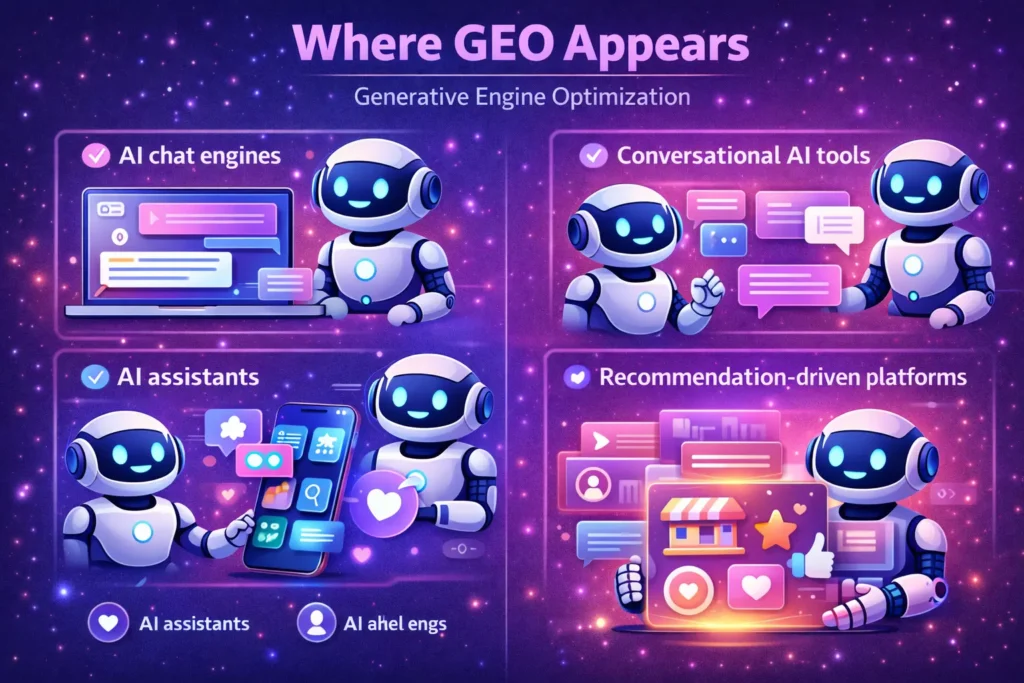
- AI chat engines
- Conversational AI tools
- AI assistants
- Recommendation-driven platforms
These systems do not simply retrieve pages. They synthesize responses based on probabilistic authority signals.
How AI Selects Brands
AI systems prioritize brands that:
- Appear consistently within authoritative discussions
- Demonstrate topical specialization
- Maintain strong review signals
- Exhibit entity clarity (consistent name, positioning, descriptors)
Mini Case Scenario
A regional digital marketing agency optimized entity consistency across directories, industry blogs, and LinkedIn thought leadership. Within six months, AI assistants began mentioning the agency when users asked for local marketing consultants.
They did not “rank” for those queries. They were recommended.
That is GEO in action.
GEO Strategic Framework
1. Entity Optimization
Ensure consistent NAP (Name, Address, Phone), brand descriptors, and structured data.
2. Brand Consistency
Align messaging across website, social platforms, and third-party mentions.
3. Topical Authority Development
Publish deep, specialized content clusters around core expertise areas.
[Link to content cluster strategy guide]
4. Citation & Mention Strategy
Earn mentions in industry publications, guest posts, and expert roundups.
5. Reviews & Trust Signals
Encourage authentic reviews and demonstrate transparent business practices.
GEO Implementation Checklist
- Audit brand consistency
- Improve About page authority signals
- Build topical content clusters
- Secure high-quality mentions
- Strengthen review acquisition process
- Maintain structured data markup
- Monitor AI responses for brand visibility
Common Strategic Mistakes to Avoid in AEO and GEO
- Treating AEO as FAQ stuffing rather than structured authority building.
- Ignoring entity consistency across platforms.
- Writing long content without extractable answer blocks.
- Over-optimizing keywords instead of context.
- Neglecting off-site citations for GEO impact.
- Assuming ranking automatically equals AI recommendation.
In several audits, I’ve seen companies rank top five but receive zero AI mentions due to weak brand context.
AEO vs GEO – Strategic Comparison Table
| Factor | AEO | GEO |
| Definition | Optimization for answer extraction | Optimization for AI recommendation |
| Primary Objective | Win direct answers | Win AI-generated mentions |
| Platform Type | Search engines & answer engines | Generative AI systems |
| Trigger Mechanism | Structured answer blocks | Entity authority & contextual trust |
| Content Structure | Question-based, concise | Deep topical authority |
| Success Metrics | Featured snippets, PAA visibility | AI mentions, recommendation presence |
| Optimization Focus | Extractability | Entity credibility |
Why Implement AEO and GEO Together?
AEO improves visibility within search interfaces. GEO improves recommendation likelihood within generative environments.
If you implement AEO alone, you may win answers but lose brand recommendation.
If you implement GEO alone, you may gain recognition but miss extractable visibility.
Together, they reinforce:
- Authority
- Discoverability
- Trust
- Conversion probability
In strategic roadmaps I design, AEO improves short-term visibility, while GEO builds long-term AI relevance.
Conclusion – The Relationship Between SEO, AEO, and GEO
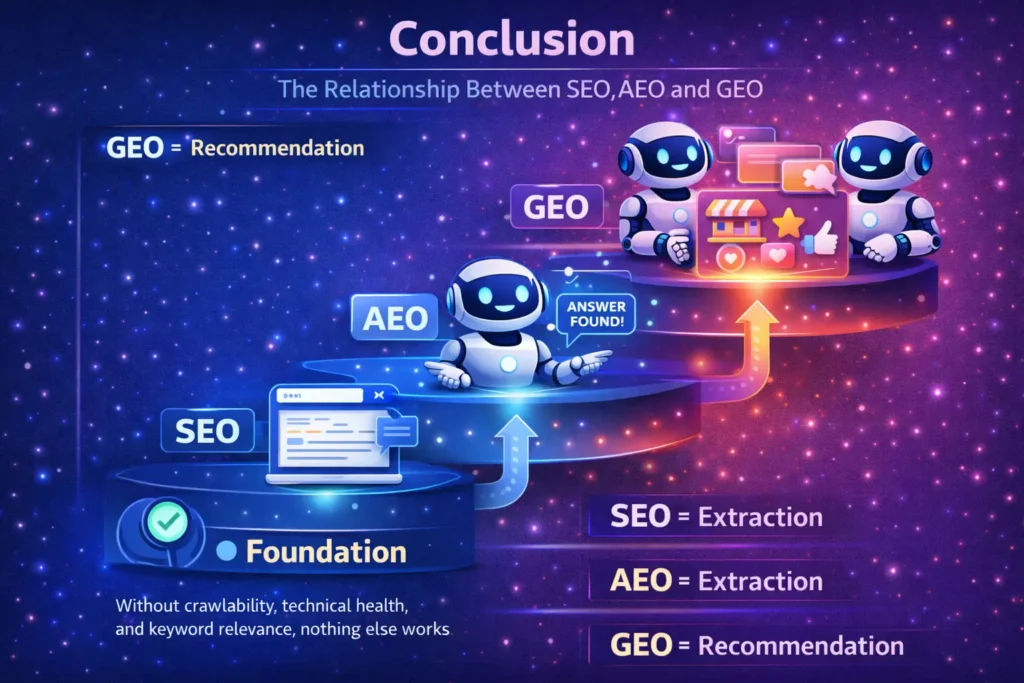
SEO remains the foundation. Without crawlability, technical health, and keyword relevance, nothing else works.
AEO builds on that foundation by enabling extraction.
GEO builds further by enabling recommendations.
SEO = Foundation
AEO = Extraction
GEO = Recommendation
Businesses that adapt to this layered model position themselves not just to rank, but to be selected.
Search visibility is no longer just about being found. It is about being trusted by algorithms that decide what gets surfaced, summarized, and recommended.
The strategic question for 2026 is not whether you should implement AEO and GEO.
It is how quickly you can.
Frequently Asked Questions
What is the main difference between AEO and GEO?
AEO focuses on structuring content so search engines can extract direct answers. GEO focuses on positioning your brand to be recommended within AI-generated responses. AEO improves visibility in answer boxes, while GEO increases AI-driven recommendations.
Is SEO still important if I implement AEO and GEO?
Yes. SEO provides the technical and structural foundation that allows AEO and GEO to function. Without strong SEO fundamentals, content may not be discoverable or trusted enough for extraction or recommendation.
How can I measure GEO performance?
Monitor AI-generated responses across platforms, track brand mentions in AI outputs, analyze entity consistency, and measure growth in branded search queries and authoritative citations.